Start screen and app list primitives
A reproducible WP8.1 emulator study of tiles, app-list surfaces, alphabet navigation, scrolling, and live content. Research/tooling/media only: no launcher or package API decision.
Scope and evidence
The reference is the Microsoft Windows Phone 8.1 WVGA emulator at 480 × 800. The authoritative registry is research/start-screen/measurements.json schema v4; canonical media provenance is docs/media/start-screen/media-index.json. This release indexes 67 registry trials across 23 scenario IDs and 20 canonical source-mapped clips; requested-outcome-failed inverse flicks remain in that registry as observed snap-backs, while pilots and superseded invalid-precondition trials are retained separately in the release. Release page · download evidence archive.
Every MP4 below is 480 × 800 H.264. “30 fps” is encoded presentation cadence only: each frame holds a preceding acquired native PNG, with no interpolation. Host capture intervals and input receipts are not guest presentation, display, or physical-touch time.
Rendered geometry
Bounds are inclusive rendered screenshot pixels, not source asset size or font point size; edge uncertainty is ±1 px unless noted.
| primitive | measurement |
|---|---|
| tile planes | large 210 × 210 px; small 99 × 99 px; 12 px gutters |
| icon/content landmarks | Rendered Phone [100,109,148,181] 49 × 73; Messaging [277,84,311,110] 35 × 27; IE [382,82,430,126] 49 × 45; Mail [278,202,311,228] 34 × 27; Calendar date/live content [107,653,226,700] 120 × 48; Kid’s Corner content [308,552,392,657] 85 × 106 |
| labels/live text | Fake GSM Network [34,237,195,253] 162 × 17; People [34,460,87,477] 54 × 18; Sun 30 [116,653,225,700] 110 × 48; Kid’s Corner [256,682,351,699] 96 × 18 |
| app list | search [25,57,67,98] = 43 × 42; header [86,57,147,118] = 62 × 62; Calculator icon [86,427,147,488] = 62 × 62; name [164,444,298,468] = 135 × 25, left x=164/top y=444; 74 px row pitch; 16 px icon/name gap; baseline y=468 |
| alphabet grid | replacement settled-grid overlay [24,19,456,785] = 433 × 767; four columns; a [135,19,233,117] = 99 × 99 and b [246,19,344,117] = 99 × 99; 12 px gutter; enabled #3e65ff, disabled #202020 |
| edit pose | Calendar [24,500,233,709]; unpin [228,456,272,500], center [250,478], diameter 45; resize [227,691,273,736], center [250,714], diameter 46; ±2 px |
Evidence and code record
Trace the exhaustive 23-ID matrix and limits through the study protocol, measurements.json, media-index.json, launcher adapter record, and evidence notice. The source/release inventory is available from the release page and the direct archive.
Start entry, Calendar exit, and edit pose
Observed entry/exit is staggered per-tile 3-D motion; exact easing and duration are unknown. Use “Play both” to launch the independent entry and exit records together. Calendar evidence ends on its recorded location prompt, not a claim about permissions.
Calculator → staggered entry → settled tiles. Corrected Home r03.
Tile fly-off → recorded Calendar prompt. Source-mapped r03.
Lateral surfaces and release outcomes
During drag, Start and list surfaces share the viewport. Each pair launches together for direct visual comparison; the recordings keep their own durations. Release outcomes are observed commit or snap-back states, not a recovered curve.
Drag and flick commits
Start → shared split → app list. Source-mapped r03.
Start flick → shared split → app list. Source-mapped r03.
Snap-back direction
List edge exposed, then Start restored. Source-mapped r03.
Start exposed, then app list restored. Source-mapped r03.
Inverse commit and failed flick
App list → shared split → Start. Source-mapped r03.
Requested inverse flick failed to commit; app list restored. Source-mapped r03.
Vertical scrolling and boundaries
These pairs show observed content displacement and boundary return. “Play both” makes differences easier to inspect without asserting clock alignment. A timing-qualified coarse gate does not establish physical latency or a native easing equation.
Start: slow scroll and flick
Start moves to lower tile and Photos content. Source-mapped r03.
Start flicks to lower content. Source-mapped r03.
App list: slow scroll and flick
A rows move to lower rows. Source-mapped r03.
A rows flick to lower rows. Source-mapped r03.
Top-boundary return
Tile grid pulled down, then restored. Source-mapped r03.
List pulled down, then restored. Source-mapped r03.
Alphabet grid and app launch
The corrected cancel session waits for list settle before the header tap. Old no-settle cancel trials remain rejected supplemental evidence because they launched Calculator.
Selection and cancellation
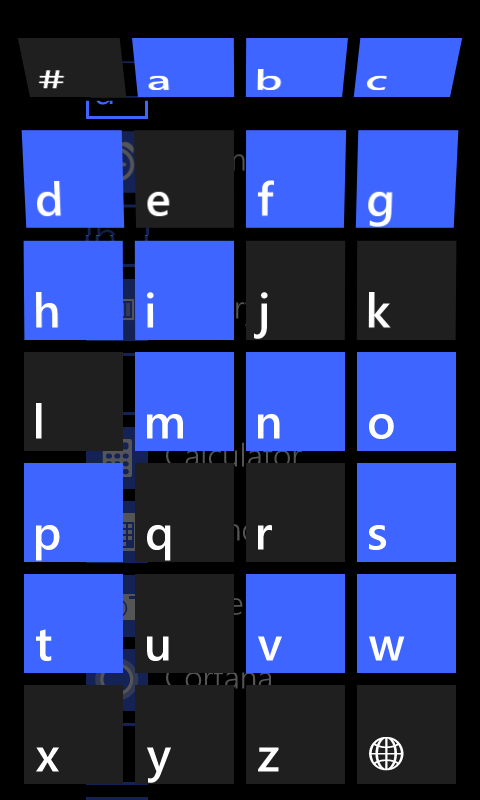
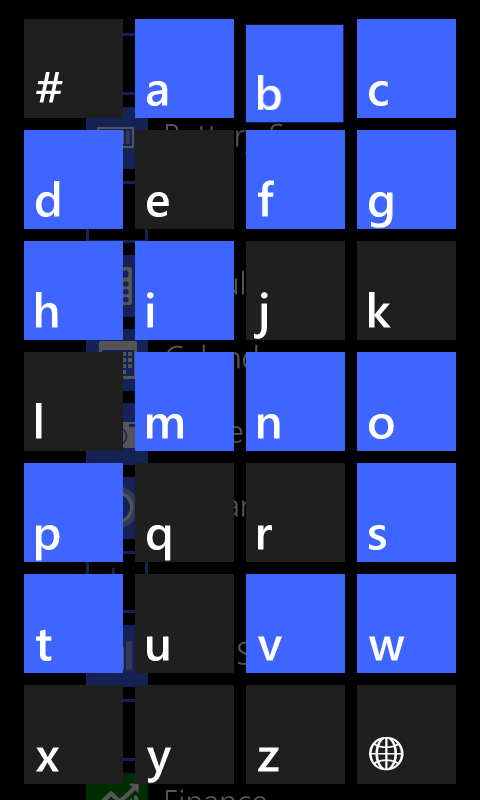
Settled grid → enabled b cell → B section. Corrected r03; behavior/geometry only.
Settled grid → Back dismissal → app list restored. Corrected r03.
People live-tile flip
This is passive native content-plane evidence, not a reconstructed shell animation. The repeat group supports behavior/geometry; its timing gate is not eligible.
Boundaries and candidate implications
No Lumia/hardware, Android-launcher, overall-fidelity, exact-font/point-size, exact-easing, or physical-latency claim follows from this emulator record. Continuous reverse-while-held is unsupported by the bridge. Microsoft-origin emulator UI is attributed evidence only, not package assets or trademark affiliation; no proprietary Segoe binary or standalone Windows artwork is redistributed.
Candidate primitives for later evaluation are a tile surface/content plane, semantic alphabet grid, app-list row, scroll/overscroll behavior, and transition orchestration. API/component selection is deferred until after research review.